Wild Children
Wild Children
30th Annual Festival of Alternative Art
.jpg)

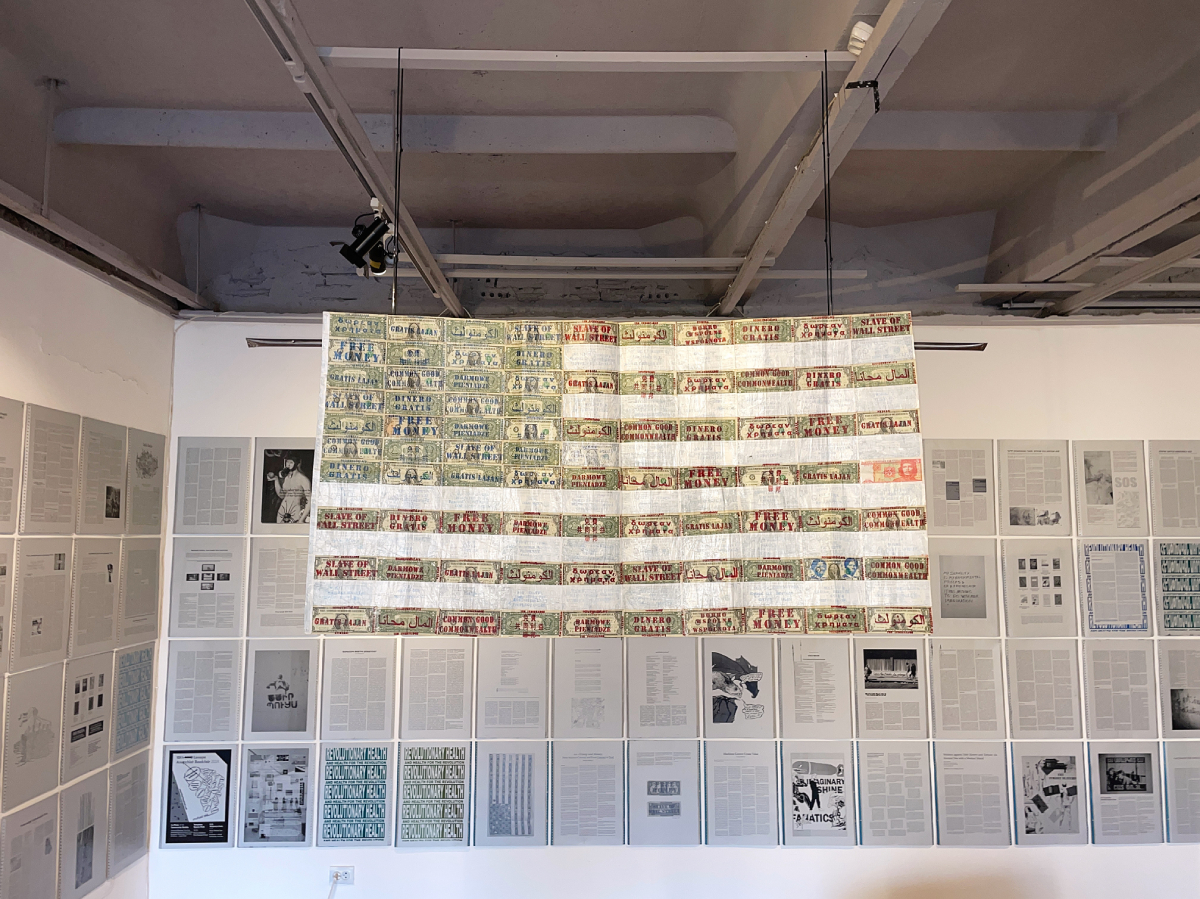
"Considering that defacing a reproduction (think of Marcel Duchamp's L.H.O.O.Q.) or a valueless traditional painting (such as in the practice of Asger Jorn) is not viewed as a criminal act or an incitement to destroy artworks in museums, we have 'vandalized' reproductions created by Chinese painters specializing in this kind of work."
Claire Fontaine intervenes on the reproduction of canonical paintings of still life, a genre strongly connected with domesticity, bourgeois life and extraction from nature through symbolic acts of vandalism, recalling the activist gestures in museums and questioning the ideas of "care" and "value" beyond their banal economic justification.
At times of relentless wars and genocides, the artworks, with their preservation granted by the cultural institution, appear almost deaf to the sufferings that surround them. The damaged painting is here proposed as the testimony of a deeper meaning that questions the state of immaculate integrity of the masterpieces as being ideal.
The practice of vandalism is therefore approached as an added value', a witness of the brokenness and the brutality of what happens outside the museum walls. Harmlessly tested on reproductions, this abstract intervention upon the figurative painting is not a real act of destruction but an open question on what kind of art is relevant in the present historical moment.
Umberto Eco writes in his celebrated 1962 essay The Open Work: "If in a burning house we find our mother and a painting by Cézanne, we save our mother first, without thereby denying that Cézanne's painting is a work of art. The contingent situation does not become a criterion for judgment; it is a determinant of choice. This is the situation that Brecht passionately denounces when he states: 'What kind of times are these, when a talk about trees is almost a crime, because it implies silence about so many atrocities!" Brecht does not say that speaking of trees is wrong. Indeed, his verses resonate with an irrepressible nostalgia for that lyrical dimension he is drawn to and must reject."
Claire Fontaine
%20(1).jpg)
%20(1).jpg)
.jpg)

.jpg)

BONBON
Cultural dessert
BONBON is a new direction in art. If no one knew anything about it until now, then tomorrow all of Yerevan will be talking about it. Everything is terrifyingly simple. You think you know the word BONBON, that it means sweets, candy. But it doesn't. BONBON means nothing.
Absolutely nothing. It is childish babbling.
In French, it may be heard as a doubled “good,” or as something “bright, beautiful, and pure.” BONBON sounds French because, for Armenians, Paris still remains the capital of all the arts.
Just a single word transforming into a social movement. Everything is terrifyingly simple. And if an artistic movement is born from that word, it is merely out of a concern to avoid confusion.
BONBON-psychology
BONBON-economics
BONBON-philosophy
BONBON-politics
Why not you as well, dear artists — you who create with canvas and brush — you too are BONBON.
BONBON-war against terrorism that never ends.
BONBON-revolution that never begins.
BONBON is also you, poet-evangelist friends.
BONBON — Arman Grigoryan
BONBON — Tigran Khachatryan
BONBON — Diana Hakobyan
BONBON — Davit Kareyan
BONBON — Sona Abgaryan
BONBON — Karine Matsakyan
BONBON — Arman Martirosyan
BONBON — Levon Fljyan
Bonbon-mabonbon, bonbom, bombom, booooooom, bonbon Arm, bonbon Ti, bonbon Di, bonbon Da, bonbon Son, bonbon Kar, bonbon Ma, bonbon Lyov.
Do you wish to attain eternal bliss — pronounce BONBON.
Do you wish to become miraculous — pronounce BONBON.
With a delicate gesture and cultivated grandeur, pronounce BONBON, until you go mad, until you completely let go.
How to rid oneself of everything slick, of all calculation and conformism, of journalisticness and moralizing, of manageability and ornamentation.
Pronounce BONBON.
BONBON is the creative spirit of the universe.
BONBON is the most fragrant shampoo in the whole world.
BONBON — mister Bush, BONBON — gospodin Putin, BONBON — nakhagah Kocharyan.
In Armenian, this means that above all else one should value Armenian hospitality, and in matters of aesthetics one should not go beyond the boundaries of traditionalism.
BONBON — Arshil Sladky, BONBON — Saryan, BONBON — Buddha, BONBON — John Lennon and Yoko Ono,
BONBON.
The significance of this word is hard to overestimate.
Arman Grigoryan
%20(1).jpg)
.jpg)
.jpg)
%20(1).jpg)
%20(1).jpg)
%20(1).jpg)
The crisis of 2008 has never truly ended. During the Great Recession, it became clear that the neoliberal model was not working anywhere in the world. The link between economic crises and neoliberal policies became evident to everyone. In Armenia, "democracy"—which had begun to be built after independence—was itself in crisis: it was both completed and derailed by the 1998 coup, leaving a stark choice between genuine democratization and overt authoritarianism. Instead of radical change, we got the pointless Mashtots Park.
The events of that time fostered the formation of activist movements and came to play a decisive role in the events that followed. Certain leftist ideas became relevant at the beginning of the 2010s. The generation born after the Soviet Union was trying to think about post-independence discrepancies in a language that gave their parents goosebumps. Those were encouraging, yet weak attempts.
Abstract criticism allowed for the accommodation of even opposing political imaginaries. In the same frame, it was possible to encounter street artists and startup entrepreneurs; countercultural icons; artists and art workers, meritocrats, technocrats and anthroposophists; newly rich programmers; drug dealers; proponents of institutional relationships and progressive fascists; LGBT activists; founding presidents; founders of competing schools of translation;; class traitors; expressionists longing to become People's Artists; practitioners of historical criticism; former political prisoners and sellers of paintings; those who preferred Moment glue to R&B; members of the Karabakh Committee; documentalists; social artists; nonconformists and opportunists; reactionaries; socialists and individualists; creative politicians; Dashnak poets; those lamenting the decline of craftsmanship; descendants of survivors; family breadwinners; freedom fighters; pacifists; paranoiacs; party members and conscientious taxpayers; ordinary petty bourgeois—and, why not, hipsters; those suffering from unrequited love; victims of non-statutory relations; importers of new strategies of struggle; pioneers of marijuana legalization; believers in the liberatory power of the Internet; advocates of cultural revolution; those who saw the obvious connection between economic crises and neoliberal politics; those rethinking Soviet modernism; pensioners; spoiled brats; and future bureaucrats.
The border-line passed between democratic demands and what was inherited in the 90’s, which was overloaded with Soviet legacy. Everything went as planned: velvet revolution, pandemic, wars, snap elections. The political field emptied at the end of the 2010’s. The problem is not even that the criticism of the government’s social policy is now being conjoined with a fascination of that same government, but rather that numerous “leftists” would successfully appear in those same platforms. Moderate solutions are truly pointless at this point. One can attach oneself to any of the long discredited political parties in order to provide opposition services to the population. Widespread depoliticization – from opportunism to theoretical abstractions – is one of the consequences of this emptiness. The intermediate moment has dragged on. Nevertheless, society is generally oppressed not so much through repression but through depression, which emerges as a result of devaluation. Ultimately, the problems of leftists are the problems of society as a whole: weakened solidarity, fragile connections, lack of experience.
We see the results of the 2008 “Great recession” today and it can continue to wreak havoc, causing chaos and destruction on a global scale. The wish to turn the clock back toward a golden age of global dominance would be illusory in the next years. And it is impermissible to create a new world order in the near future. And evertheless, in a paradoxical way, with the backdrop of moral and political capital, we are today more visible and capable of developing autonomous initiatives on all levels.

%20(1).jpg)
The 30th Annual “Wild Children” Alternative Festival is not merely a platform for exhibition, but a place of ideas, of course if those are present – whether in the sense of the aesthetic or the political.
We don’t have a future as far as leftists are associated with the past. It has nothing to do with calculation: two steps forward, one step back, and one plus one does not equal two, because we are capable of counting to three. And if we are taught to keep counting, we will enter the infinity of numbers. Feminists have long spit on Hegel and Mickey Mouse flies to Mars and his laughter pierces a hole in iron. We want to live in a dirty city, where children smell of sweat and gunpowder.
Would you, in fact, like to participate in this exhibition if you know that it could have a bad effect on your career? Art is not a place to satisfy one’s neuroses, to overcome the tormenting resonance of the Armenian language/ especially Sevakian/ powerlessness is a tool and the limits of possibility are an experiment, the absence of a common language is a fight, boredom is potential, the formation of an ideological language is important, disgusting pathos is pathetic, beauty according to your imagined taste has no place here, art must be naïve and beautiful, I will understand what is art sooner than you can explain art to me, to be a fool – be brave, art is the only way to not be alone, the phone ringing is the interruption and your alibi is shopping․”


.jpg)
%20(1).jpg)
The festival is initiative by artists Grigor Simonyan and Tigran Khachatryan․