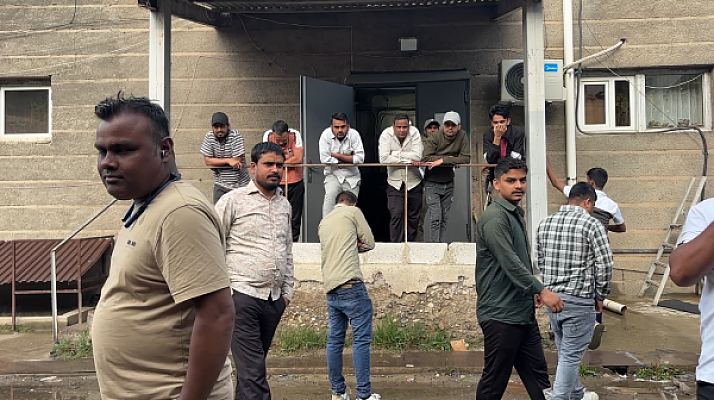
How Migrant Workers Live and Why They are on Strike in Ijevan
Citizens of India working at the garment factory in Ijevan went on strike on May 8. Epress.am managed to enter the territory of the “semi-closed” factory, where the migrants not only work but also live, and spoke with participants of the strike as well as the company’s director. More details are available in the video. Armenian and English subtitles are available.
Around 170 Indian tailors work at the “Grand Textile” garment factory in Ijevan. They describe the “production quotas” imposed by the new Russian director as labor torture. Since last week, they have stopped going to work and are demanding their May salaries and airplane tickets from the employer so they can return to India.
After last year’s strike, the Russian company fired the Armenia-based managers who had held workers at gunpoint, demanding that the migrant workers “sew faster.” The physical violence has stopped. Pure exploitation remains.
Groups of 18–19 tailors are forced to work 11 hours a day, and during a single shift they are expected to sew around 120 sets of uniforms. The new boss is now demanding 200 sets. The workers consider this impossible: “We are human beings, not robots.”
In a conversation with Epress.am, the director attempted to deny the accusations, insisting that nobody is being asked to do anything impossible. According to him, the labor dispute arose not because of overexploitation, but because of the workers themselves. He claims they violate contractual provisions by going to the bathroom too often and listening to music through Bluetooth devices. The director considers this a provocation, since “phones are prohibited by contract,” “the possibility of going to the toilet should not be abused,” the factory’s technicians monitor the workers’ productivity with second-by-second precision.
Trilingual notices are pasted on the walls of the garment factory. One of them states that:
The working day starts at 8:00 a.m. and ends at 7:00 p.m. Out of the 11 hours — 39,600 seconds — workers may spend 3,600 seconds on a lunch break, while a maximum of 1,800 seconds is allocated for “drinking/shitting/threads.” During the remaining 34,200 seconds, the tailors are expected to sew continuously.
Another notice states that workers who fail to hand over their phones to the supervisors will be fined 50 dollars. Those who do not clean their sewing machines will be fined 5 dollars.
The garment factory is located in the premises of a former department store. The tailors both work and live there at the same time.
A total of 170 people have been crammed into just a few metal barracks. Between 9 and 12 people sleep in each room. The bathroom — a concrete area with three stalls — does not even have showers. People are forced to wash themselves bent over under faucets.
The entire area is infested with bedbugs and cockroaches. The director believes the problem lies with the workers themselves — claiming they are “not clean” and so on. Supposedly, the company has provided them with a kitchen, but the workers take food to their rooms instead. Yet there is not even space to sit in the rooms. And the “kitchen” itself is a narrow barrack half-covered with chipboard panels. All 170 workers cannot even fit there and are forced to eat in shifts.
There are no cleaners, and no disinfection is carried out. According to the workers, the director does not even provide chemicals so they can at least try to get rid of the insects themselves.
“And what was I supposed to do — provide them with a five-star hotel?” the employer says in his defense. According to him, the conditions comply with the “standards.”
On May 12, the employer and representatives of the workers arrived in Yerevan at the Embassy of India. After negotiations, the director refused to meet the strikers’ demands. He considers the written commitment signed on behalf of the company — which the workers cite — to be fabricated. The tailors refuse to return to work unless the latest production quotas are revised: “We somehow managed 120 sets per day, but 200 is impossible.”
Update — Further developments: